Posts

Showing posts with the label open foam training

How do I learn computational fluid dynamics (CFD)? using OpenFOAM software

Image
How Do I Learn CFD Using OpenFOAM? A Practical Guide Want to learn computational fluid dynamics (CFD) using OpenFOAM? The best way isn't to memorize solver names or copy tutorial files. You need a structured path that starts with fluid mechanics and numerical methods, then moves into meshing, boundary conditions, solver selection, post-processing, verification, and real engineering projects. OpenFOAM is particularly useful for this approach because it gives you direct access to case files, numerical settings, physical models, and solver controls. That makes it a strong learning platform for students, researchers, and engineers who want to understand what happens inside a CFD simulation rather than treating the software as a black box. In This Article What is CFD and why learn it? Why learn CFD with OpenFOAM? Prerequisites for learning CFD CFD learning roadmap using OpenFOAM Step-by-step OpenFOAM learning path Projects that build practical CFD skills Common ...
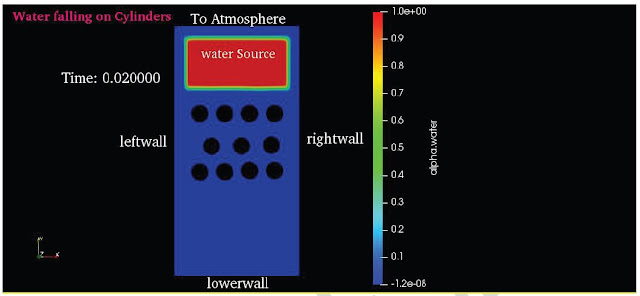
TUTORIAL 04: CFD ANALYSIS OF WATER FALLING ON CYLINDRICAL SURFACE USING INTERFOAM SOLVER

Image
Tutorial 04 : CFD analysis of water falling on cylindrical surface using interfoam solver of OPENFOAM. Figure 4.1 (a) Initial volume fraction (VF) of water Contour of free water falling with BCs Figure 4.1 (b) Meshed domain of water falling Problem Identification In this problem investigation of free water falling using OPENFOAM is proposed for multi phase modeling (free water falling cooling), in which water is flow in free water falling from prescribed location section from top initial condition (see figure), which is assumed at surface of top side wall (See the following figure). Air and water properties are selected from literature available in digital medium. Outlet is at top of the domain which is selected for continuity effect of free water falling system. Some assumptions are applied in this problem like initial room temperature is assumed at constant value for this problem (ISOTHERMAL). Air and water properties are also assumed constant for this problem. ...